Music & Memory
You have 3,000 songs on Spotify. How many actually matter?
Open your Spotify library. Scroll through your liked songs. There are probably hundreds. Maybe thousands. Years of listening, all stacked up in a list.
Now ask yourself: how many of these actually mean something?
Not “how many do you enjoy.” How many hold a moment? A person? A feeling you can only access through that specific song?
Probably not thousands. Probably a handful. Maybe a dozen. The ones that aren't just songs — they're timestamps.
I've been thinking about this a lot lately. Spotify Wrapped comes out every December, and it tells me my top artists, my most-played tracks, my “listening personality.” It's fun. It's shareable. It's also completely missing the point.
Because my most-played song of the year isn't the song that mattered most. The song that mattered most might be something I played once, in a specific moment, and haven't touched since. It's sitting somewhere in my library, buried under algorithm-friendly picks and background playlists. Wrapped will never surface it. The algorithm doesn't know it exists.
Your listening history isn't your music story.
Your music story is the song that was playing when you drove away from your hometown for the last time. It's the track your roommate played every Sunday morning until it became the sound of home. It's the one that came on at the wedding, or the funeral, or the random Tuesday that turned out to matter.
Scientists call these “music-evoked autobiographical memories” (MEAMs). Unlike regular memories, which fade and distort over time, music-linked memories remain vivid and emotionally charged — sometimes for decades. Research shows that songs become “cues that trigger autobiographical retrieval,” pulling entire experiences back into consciousness. Read the research →
These songs don't show up in your stats. They're not your “top” anything. But they're yours in a way that your most-played tracks will never be.
There's also something called the reminiscence bump — a phenomenon where we form the strongest emotional connections to music from our teenage years and early twenties. A global study of nearly 2,000 people found that our most meaningful songs tend to come from around age 17, give or take a few years.
“Think of the adolescent brain as a sponge, supercharged by curiosity and a craving for reward, but without a fully developed filter,” explains Dr. Iballa Burunat, lead author of a University of Jyväskylä study. “Our strong emotional experiences, such as the songs we love, get absorbed more deeply and vividly, and leave a lasting impression.” Read the study →
This explains why a song from high school can hit harder than anything released last year. It's not that the music was better. It's that your brain was more open, more impressionable, more ready to fuse a song with a feeling forever.
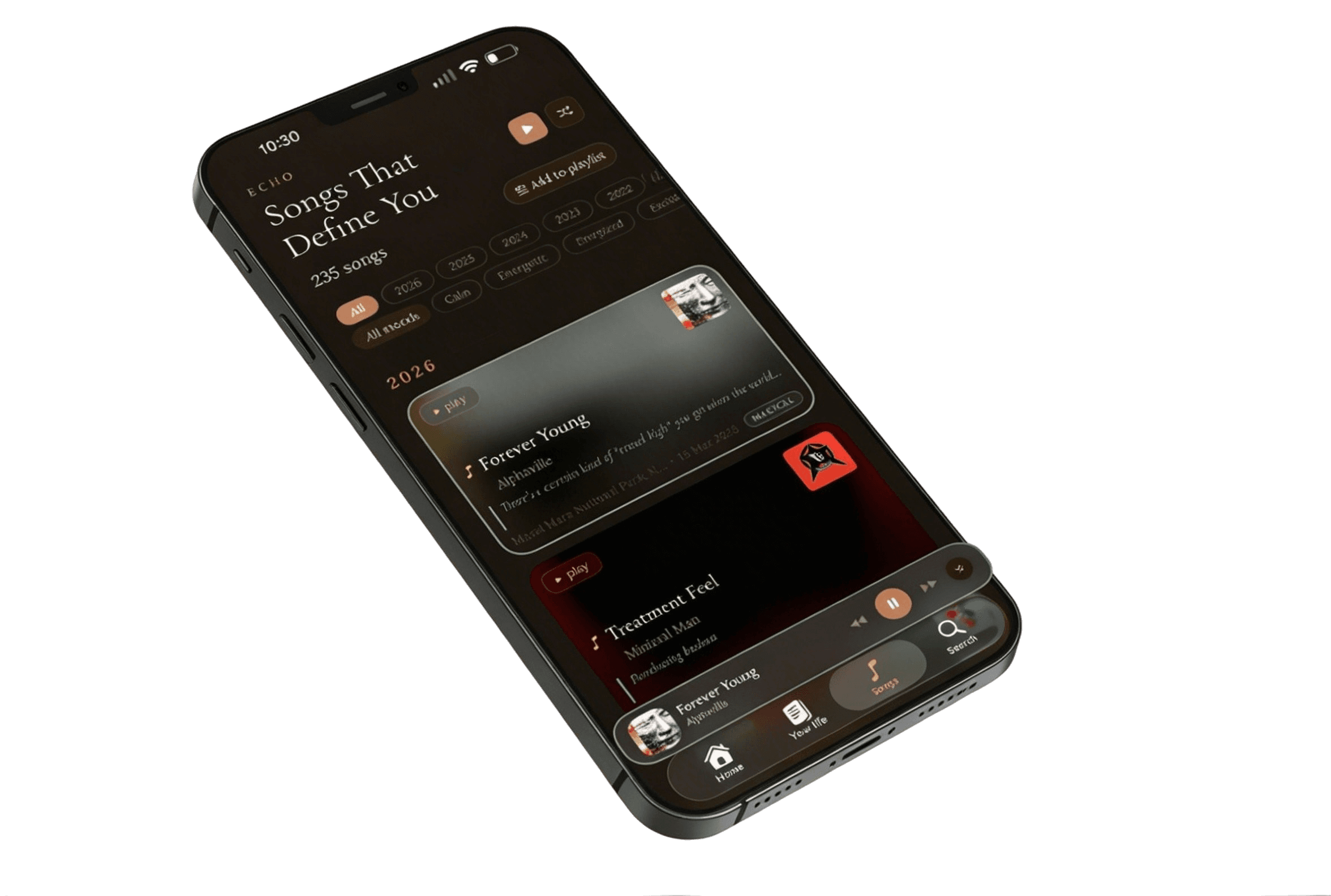
I wanted a place for just those songs. Not a playlist — playlists are for listening. This is for remembering. A place to keep the songs that hold something, alongside the moments they hold.
That's what Echo is. A music memory app. You save a moment, attach the song, and it stays there — not shuffled, not algorithmic, just yours.
Because the songs that matter aren't always the ones you played most. Sometimes they're the ones you can barely listen to.
The songs that matter deserve more than an algorithm. They deserve a place.
Get Echo — it's free