Memory & Music
He forgot my name. But he still knew every word.
My grandfather stopped recognizing me about a year before he passed. He'd look at me the way you look at someone you're sure you've met before — searching, polite, a little apologetic. My name was gone. My face, unfamiliar. Our shared history, mostly gone.
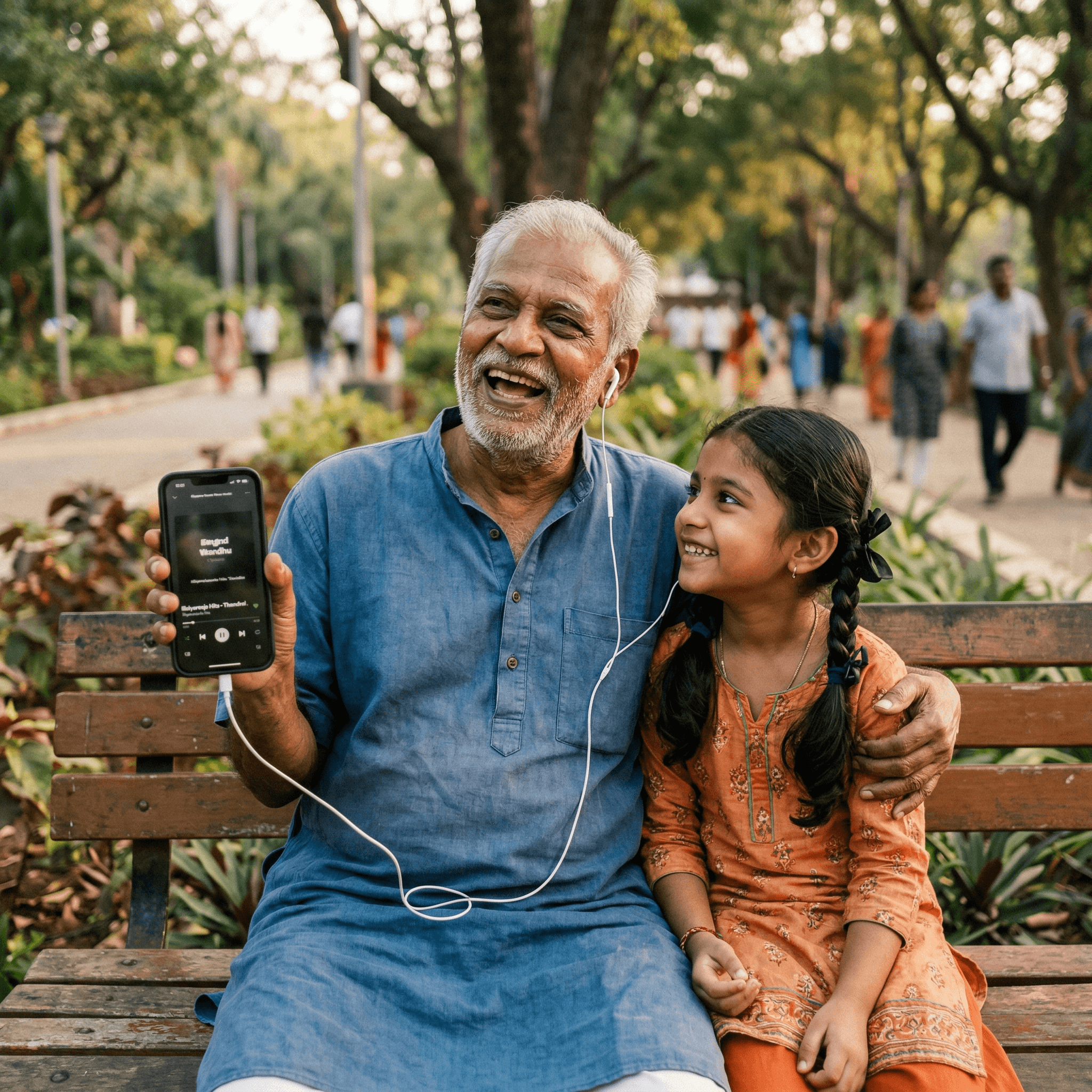
But put on Mohammad Rafi, and something shifted. His eyes would light up. He'd start to hum. Then he'd sing — every single word, perfectly — lyrics from songs he first heard sixty years ago. He was still in there. Music had kept a door open that everything else had closed.
Why music survives when everything else fades
Dementia is a slow erasure. It moves through the brain methodically — dissolving names, faces, dates, conversations. But music lives somewhere different. It's stored across multiple regions of the brain simultaneously, and the areas associated with musical memory are among the last to be damaged by Alzheimer's disease.
This isn't just poetic. It's neurological. The procedural memory that holds learned skills — how to ride a bike, how to sing a song you've sung a thousand times — is stored separately from the episodic memory that stores facts and faces. Which is why someone who can no longer tell you what year it is can still conduct an imaginary orchestra to Beethoven's Fifth without missing a beat.
Music also unlocks emotion in ways that language can't. A familiar song doesn't just trigger a memory — it triggers the feeling of the memory. The safety. The warmth. The specific quality of a lazy afternoon in 1965. For someone with dementia, that emotional retrieval can be the only way back to themselves. Learn more →
The playlist that could change everything
There's a program called Music & Memory — now used in thousands of care facilities — built on a simple idea: give people with dementia personalized playlists of the songs that mattered to them, and watch what happens.
What happens is remarkable. People who hadn't spoken in weeks begin to talk. People who are agitated and withdrawn become calm and present. Families recognize their loved ones again — for a few minutes, sometimes longer — in the space a single song can open.
The hard part is knowing which songs. The program relies on family members to reconstruct the musical history of a person who can no longer tell them. What did she listen to as a teenager? What was playing at her wedding? What did he always sing in the kitchen on Saturday mornings?
Most families don't know. Because no one thought to ask.
The urgency of capturing music memories now
There's a version of this story that's not about dementia. It's about the years before — the decades when a person is still fully themselves, still capable of telling you exactly what song made them cry at their brother's wedding, what was playing the summer they fell in love, what they always turned up on long drives.
Those stories live in people. And they're quietly disappearing every day — not to dementia, just to ordinary forgetting. To the assumption that we'll remember later, that there's time to ask, that the details will keep.
They don't.
Families trying to build personalized playlists for loved ones with dementia often find themselves guessing. They know the rough outline — the era, the genre, maybe a few famous names. But the deeply personal songs — the specific track that anchored a specific feeling in a specific year — those are almost always gone.
What we're really talking about is a kind of documentation. Not the clinical kind. The kind that keeps a person whole.
What you can do — starting today
You don't have to wait for a diagnosis to start paying attention to the songs that matter. The practice of noticing — this song, this moment, this feeling — is something any of us can begin.
Ask your parents what was playing at their wedding — and write it down. Ask your grandparents what they listened to when they were young. Notice what's playing in the moments that feel significant. The ones you already know you'll want to hold onto.
These aren't just songs. They're the emotional shorthand for a whole life. And they're recoverable — if you capture them while the person is still there to tell you.
This is part of why we built Echo — not for the moment you create a memory, but for the decades that follow. A song attached to a feeling, saved when both are vivid, becomes something irreplaceable later.
We think about it this way: the memories you save today might be the ones that reach someone you love long after words can.
My grandfather is gone now. But I still have Mohammad Rafi. And whenever I hear him, I see my grandfather — eyes lit up, singing along, completely himself. He didn't leave a record of the songs that mattered to him. I wish he had.
You still can.
The memories you save today might be the ones that matter most tomorrow.
Get Echo — it's free