Music & Memory
Not what happened. How it felt.
Open your Google Photos. Scroll back three years. Find a random photo from a day you'd forgotten about.
You see where you were. You see who you were with. Maybe you're smiling. Maybe you're at a restaurant, or a park, or someone's apartment. The photo proves you were there.
But here's the question: do you remember how you felt?
I've been doing this exercise lately, scrolling through old photos, trying to remember the emotional reality of those moments. And most of the time, I can't. The photo gives me facts — location, date, faces — but not feelings. I know I was there. I don't know what it felt like to be there.
Then I hear a song. And suddenly I'm not just remembering — I'm feeling it again.
That's the thing about music. It doesn't give us information. It gives us access. The song that was playing during that dinner, that trip, that conversation — when I hear it, I'm not looking at the memory from outside. I'm back inside it.
UC Davis neuroscientist Petr Janata discovered why this happens. Using brain imaging, he found that the medial prefrontal cortex — the region that stores autobiographical memories — is the same region that processes familiar music. “A piece of familiar music serves as a soundtrack for a mental movie that starts playing in our head,” he explains. The brain doesn't just recall the memory; it replays the entire emotional experience. Read the study →
Photos are evidence. Songs are portals.
But we treat them completely separately. We have photo libraries, organized by date and location and face. We have music libraries, organized by artist and genre and playlist. Nothing connects them. The song and the moment exist in different places, and the link between them lives only in our heads — until we forget it.
This is also why music therapy works for Alzheimer's patients. The medial prefrontal cortex — where music and memory intersect — is one of the last brain regions to deteriorate. Patients who can't recognize their children can still sing along to songs from their youth. The music-memory pathway is that fundamental to who we are. Learn more →
I wanted to fill that gap. A place where the song and the moment stay together. Not a photo album. Not a playlist. Something in between — where the memory has both the image and the sound, and neither one is complete without the other.
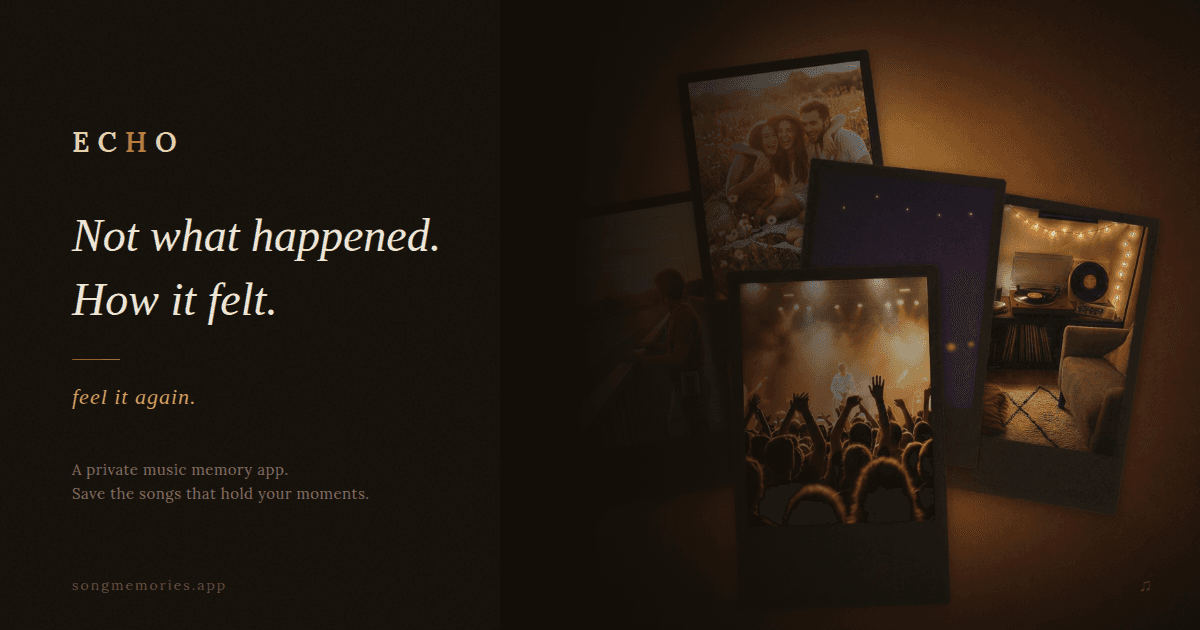
That's Echo. A music memory app. You save a moment, attach the song that holds the feeling, and it's there — whenever you need to feel it again.
Because photos show where you were. But music remembers how it felt.
And that's the part we actually want back.
Not what happened. How it felt. That's what Echo preserves.
Get Echo — it's free