Capturing Moments
You're going to forget how this felt
Right now, wherever you are, something is happening.
Maybe it's small. A dinner with friends. A drive home. A night that doesn't feel particularly special. Just another evening, another set of hours passing.
In five years, you might not remember this happened at all.
That's not pessimism. That's just how memory works. We think we'll remember the important moments, but we don't always know which moments are important until later. And by then, the details are gone. The feeling has faded. We're left with a vague sense that something happened, but we can't quite reach it.
Photos help. But photos capture what things looked like, not how they felt.
You know what captures how things felt? The song that was playing.
I've been thinking about this a lot. The moments I remember most vividly aren't the ones I photographed. They're the ones where a song was playing — and now, whenever I hear that song, I'm back there. Not remembering the moment. Feeling it. The energy of the room, the mood of the night, the exact emotional temperature of that specific time.
Researchers at UCLA found that emotions stirred by music create uniquely powerful memories. “Music helps to think of it like a scent: it bypasses our brain's language centers and brings a past moment to life in a non-verbal, immediate way,” explains one neuroscientist. “But unlike a smell, music unfolds over time — its rhythm, melody, and structure provide a timeline that allows music to act as both a time machine and a storyteller.” Read the research →
The song holds what the photo can't.
But here's the problem: I don't always know which song was playing. I was there, I heard it, and then I forgot. The moment passed, the song moved on, and now that feeling is locked in a track I can't name.
That's the thing about the present — it doesn't feel like it needs preserving. This party, this dinner, this night. It's just happening. Why would I stop to save it?
Because you're going to forget how this felt. And the song playing right now is the only thing that can bring it back.
Your brain is most receptive to forming these powerful music-memory connections right now — in your teens and twenties. This is the “reminiscence bump” period, when emotional experiences get encoded most deeply. The songs you connect to moments today will be the ones that transport you back decades from now. Read the research →
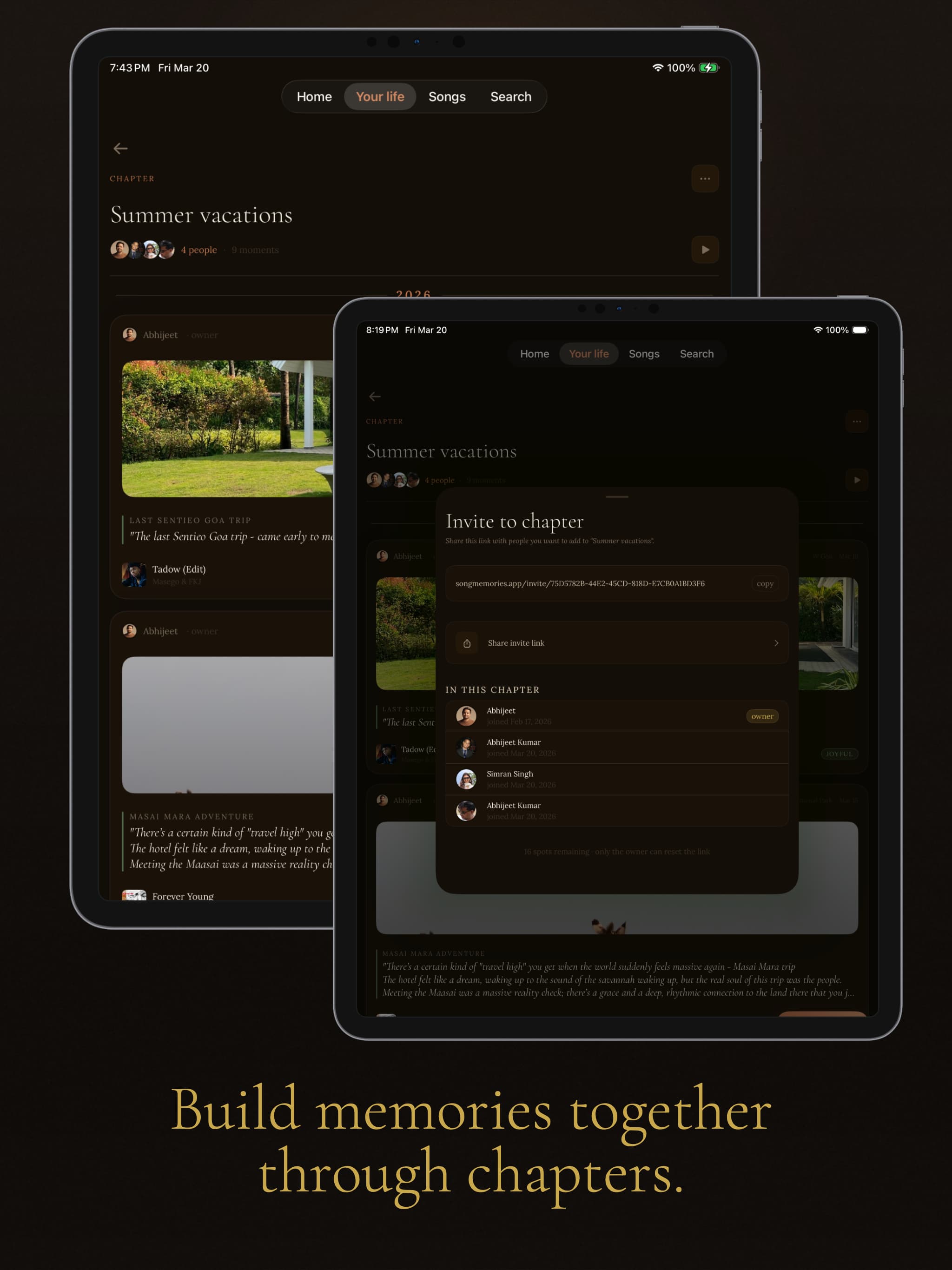
That's why I built Echo. A way to capture moments while they're happening — with the song attached — so that future-you can feel what present-you is feeling. It takes ten seconds. And it means that five years from now, you won't have lost this.
The moments happening now are future memories. But only if you capture them.
Your future self will want to feel this again. Give them a way back.
Get Echo — it's free